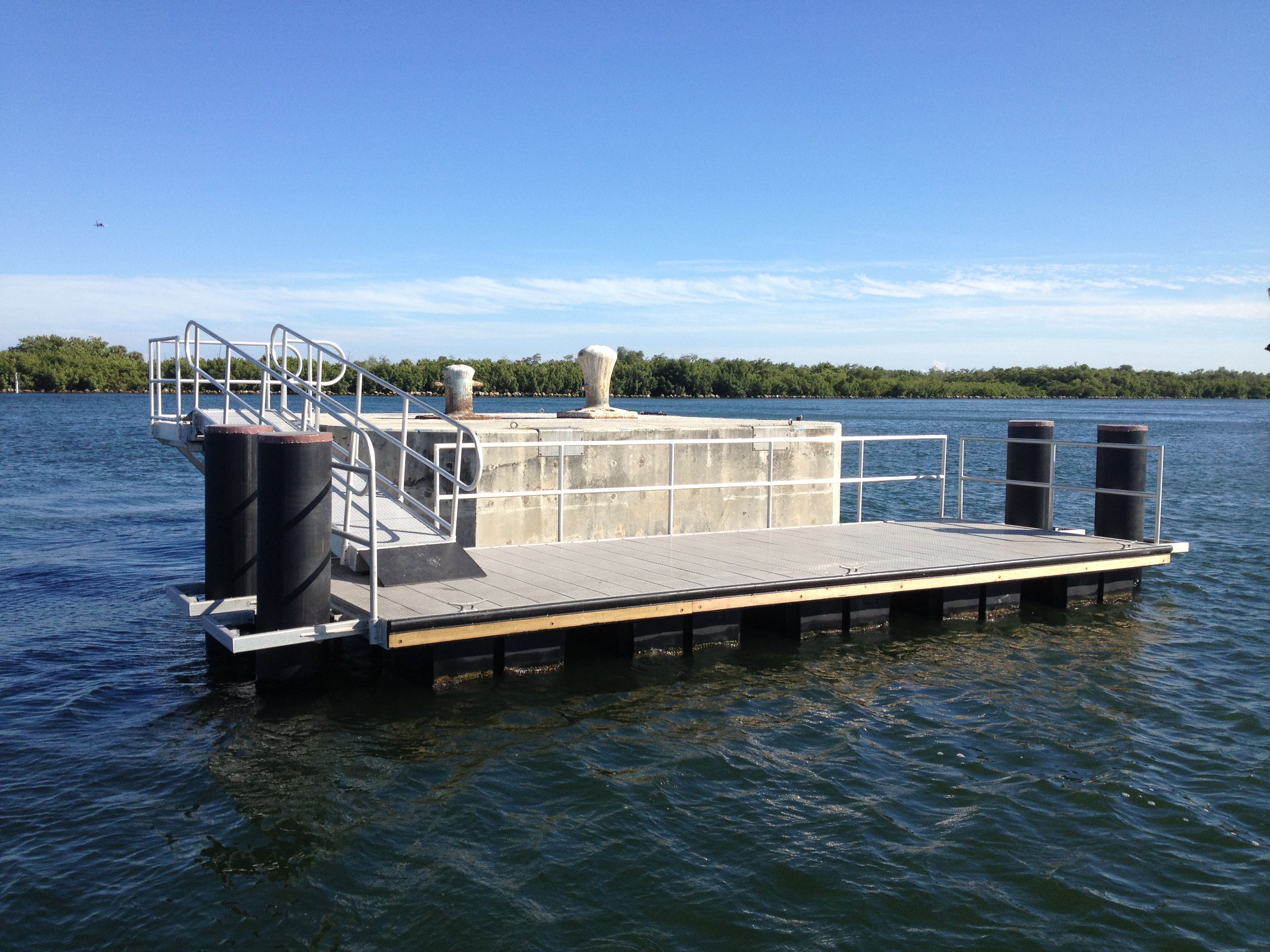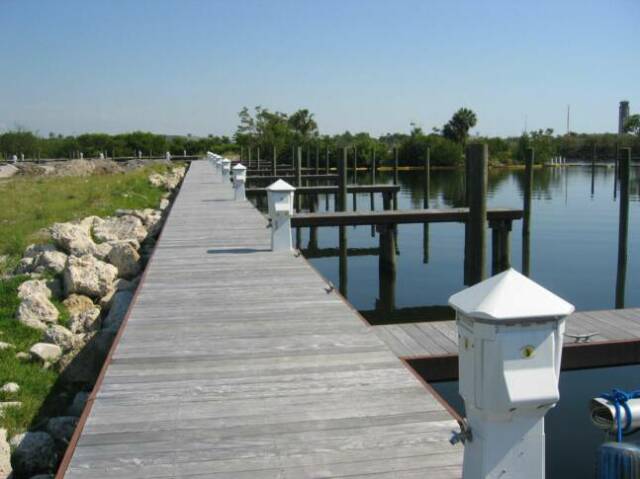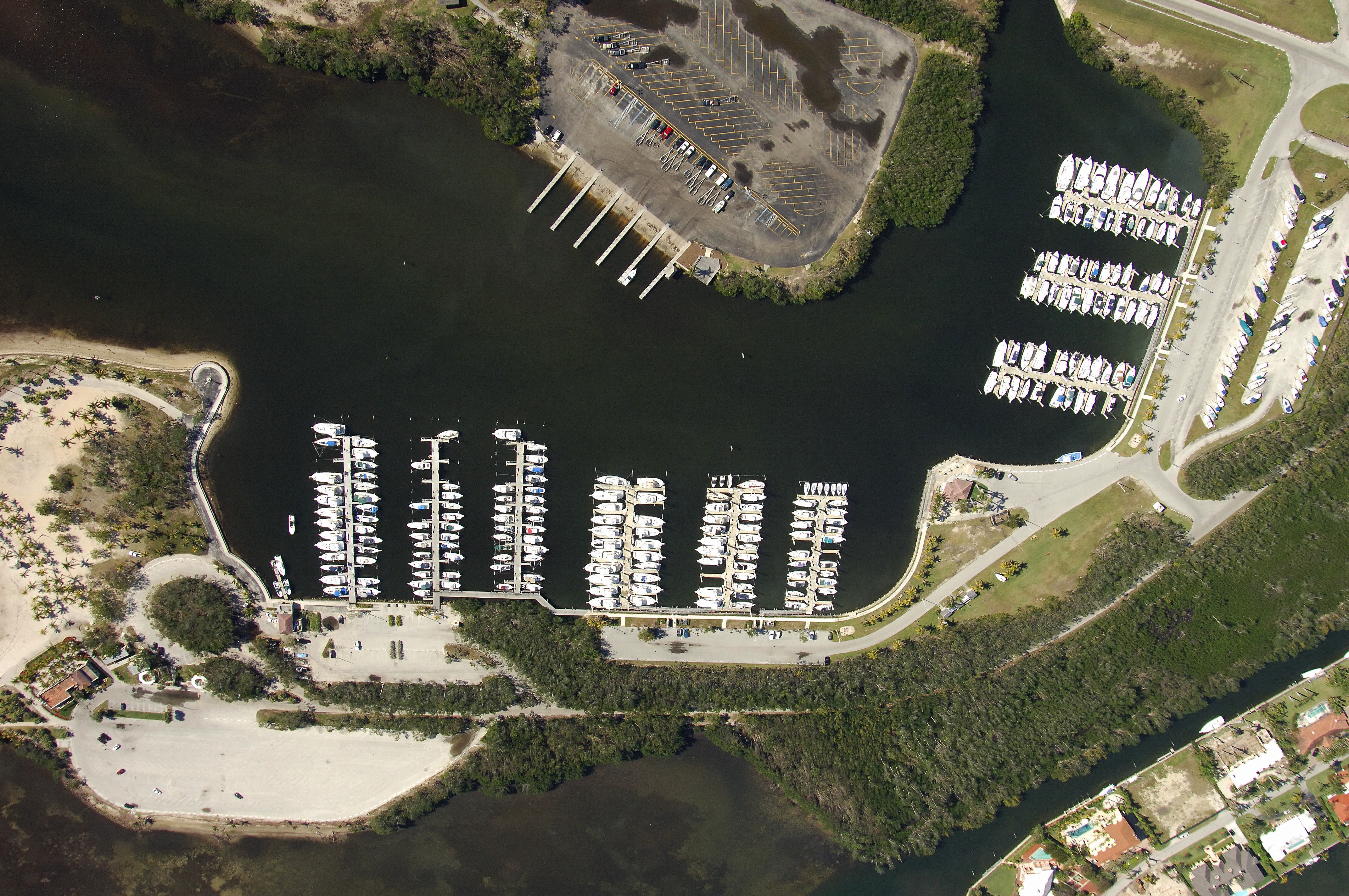
Matheson Hammock Park & Marina in Coral Gables is a heavily used public facility on Biscayne Bay, managed by Miami‑Dade Parks and Recreation. It offers fixed and floating docks, fuel, and wet slips for vessels up to roughly 55 feet, making dock reliability and downtime critical concerns for the county and local boaters. The long‑term performance of its aluminum piers—especially through Hurricane Andrew—offers a powerful real‑world example of resilient dock design in South Florida’s hurricane environment.
From Concrete to Aluminum: A Strategic Design Shift In 1982, construction of Piers G, H, and I at Matheson Hammock Marina was originally bid using concrete. An alternate design was proposed using aluminum dock systems instead of the specified concrete. The aluminum option came in at a lower cost than the original concrete design, underscoring that resilient materials do not always require a premium when optimized structurally and fabricated efficiently.
Crucially, this alternate was not just a cost‑cutting measure. The structural design of the aluminum dock system was reviewed and approved by the Dade County Department of Parks and Recreation, confirming that it met the county’s performance expectations for a busy public marina. The Coral Gables Board of Architects also approved the aesthetics, demonstrating that the aluminum solution could satisfy both engineering and architectural review boards in a highly visible waterfront setting.
Designed for 120 mph, Tested by a Category 5 The aluminum docks at Matheson Hammock were structurally designed for a wind force of 120 mph, with the assumption that no boats would be tied to them under design‑level storms. This design basis reflected common practice at the time, when forecast accuracy and evacuation procedures were different than today. A decade later, in August 1992, Hurricane Andrew struck southern Miami‑Dade County as a Category 5 storm with estimated sustained winds in the 140–165 mph range and gusts recorded up to roughly 170–177 mph near Biscayne Bay.
In reality, when Andrew hit, the large boats were still tied to the docks. Instead of experiencing only wind and wave loads, the piers had to resist massive additional forces transmitted through mooring lines and fenders as vessels surged, yawed, and heaved in hurricane‑force conditions. This combination of extreme wind speeds and vessel impact loads pushed the system well beyond its original design assumptions.
Performance Under Extreme Loading The outcome under Andrew’s onslaught provides a rare, full‑scale, real‑world test of the aluminum dock system:
The piles on Pier I broke and that pier was destroyed in the storm.
Piers G and H experienced damage, but they remained largely intact and were readily repairable afterward.
From an engineering perspective, this outcome is significant. The failure mode was tied primarily to pile performance and extreme loading conditions—winds well above the original 120 mph design level, combined with large boats still moored to the docks—rather than a fundamental weakness in the aluminum framing itself. In fact, the relative ease of repairing Piers G and H demonstrates one of the practical advantages of modular aluminum dock systems: damaged components can be replaced or upgraded without demolishing the entire structure.
For Giralt Enterprises, this type of case history is invaluable. It shows how to parse storm damage into what failed (piles, connections, overstressed components) and what performed as intended or better than expected (deck framing, system continuity, and repairability), feeding directly into modern design refinements.
Upgrading Pier I: Stronger Deck Systems and Modern Lessons Following Hurricane Andrew, a new Pier I was fabricated and installed at Matheson Hammock using a then‑new, stronger 12‑inch aluminum deck system. This upgrade reflects a core principle of resilient design: when rebuilding after a failure, do not simply replicate the original configuration—use the opportunity to increase capacity, improve stiffness, and refine connection details based on observed performance.
The enhanced 12‑inch deck system increased section depth, which improves bending stiffness and strength, and often allows better routing and protection of utilities within the dock cross‑section. By pairing this stronger deck system with appropriately designed piles and connections, the reconstructed Pier I was tailored to withstand both higher environmental loads and the real‑world condition of vessels remaining moored in certain storm scenarios.
Today, in 2026, Pier I still looks essentially new after decades of service in a harsh marine environment. Routine exposure to saltwater, sun, and daily boat traffic has not produced the systemic deterioration commonly seen in unprotected steel or aging timber structures. Meanwhile, the original decking on Piers G and H has experienced some damage over time, but those issues have been addressed through relatively straightforward repairs—another indicator of the practicality of aluminum dock systems for long‑term maintenance.
Why Aluminum Performed So Well The Matheson Hammock experience highlights several advantages of aluminum dock construction for Florida marinas:
Corrosion resistance: Marine‑grade aluminum, properly detailed and protected from galvanic interactions, offers excellent resistance to the continuous salt spray and immersion typical at Biscayne Bay and similar Florida sites.
High strength‑to‑weight ratio: Aluminum dock components can be lighter than equivalent concrete or steel systems, simplifying installation and reducing demands on pile foundations while still meeting strength requirements.
Modularity and repairability: Aluminum dock systems are often fabricated as modular sections. After Hurricane Andrew, damaged components on Piers G and H could be replaced without wholesale demolition, minimizing downtime for marina operations.
Aesthetics and adaptability: Approval by the Coral Gables Board of Architects reflects aluminum’s ability to meet architectural expectations, whether with clean modern lines or more traditional profiles and finishes suitable for high‑profile parks and marinas.
For Giralt Enterprises, these attributes align with modern priorities in coastal infrastructure: resilience, lifecycle value, and the capability to restore service quickly after extreme events.
Implications for Today’s Florida Waterfront Projects Hurricane Andrew remains one of the strongest and costliest hurricanes to strike the United States, and it fundamentally reshaped building codes and engineering practice in South Florida. Case studies like Matheson Hammock’s aluminum docks demonstrate that well‑engineered, alternative materials can not only meet but exceed real‑world performance expectations under storms that surpass original design criteria.
For today’s waterfront owners, operators, and agencies, several key lessons emerge:
Design for reality, not just the code book. Assuming no boats will be tied during a major storm may be optimistic. Modern designs should consider load cases that include moored vessels, especially for public marinas that may be hard to evacuate fully.
Invest in foundations and connections. As Pier I’s original pile failures showed, dock systems are only as strong as their foundations and critical connections. Coordinated structural and geotechnical design is essential.
Use post‑event data to guide upgrades. The move to a stronger 12‑inch deck system on the rebuilt Pier I is a model for how to incorporate lessons learned into reconstruction rather than simply replacing “in kind.”
Prioritize maintainable systems. The ease of repairing Piers G and H, and the like‑new condition of the rebuilt Pier I, underscore the value of modular, corrosion‑resistant designs that can be inspected, maintained, and upgraded over time.
Giralt Enterprises applies these principles across Florida dock and marina projects, combining material selection (such as aluminum dock systems), robust pile and connection design, and hurricane‑focused load modeling informed by events like Hurricane Andrew. For clients, this translates into waterfront facilities that are safer, more resilient, and better positioned to withstand the next generation of coastal storms while remaining attractive and functional for everyday use.